Yerba Mate isn’t one flavour. It’s a spectrum as wide as wine or whisky, shaped by country, cut, smoke, age, and the temperature of the water you pour. A shade-grown chimarrão from Paraná tastes nothing like a barbacuá from Corrientes. A wild-harvested Brazilian yerba that wants 85 °C water breaks every rule on the temperature slide.
I am in love with yerba mate. The way it asks you to slow down. The way it turns a room of strangers into a circle. The gourd moving from hand to hand. The cebador quietly taking the first bitter sip.
We’ve built an entire culture around individual cups, my coffee, my mug, my order, my name misspelled on the side. Mate is the opposite. One gourd, shared. You drink from where someone else just drank. You wait your turn…
I recently did organize a mate meetup at work, and this article is based on the talk I gave. Enjoy.
First things first: mate is not a tea. Ilex paraguariensis grows in a surprisingly small pocket of the world: northern Argentina, southern Brazil, Paraguay, Uruguay, roughly 540,000 km². And the word mate itself comes from Quechua mati, which means gourd. It named the vessel before it ever named the drink.
A whole continent’s companion
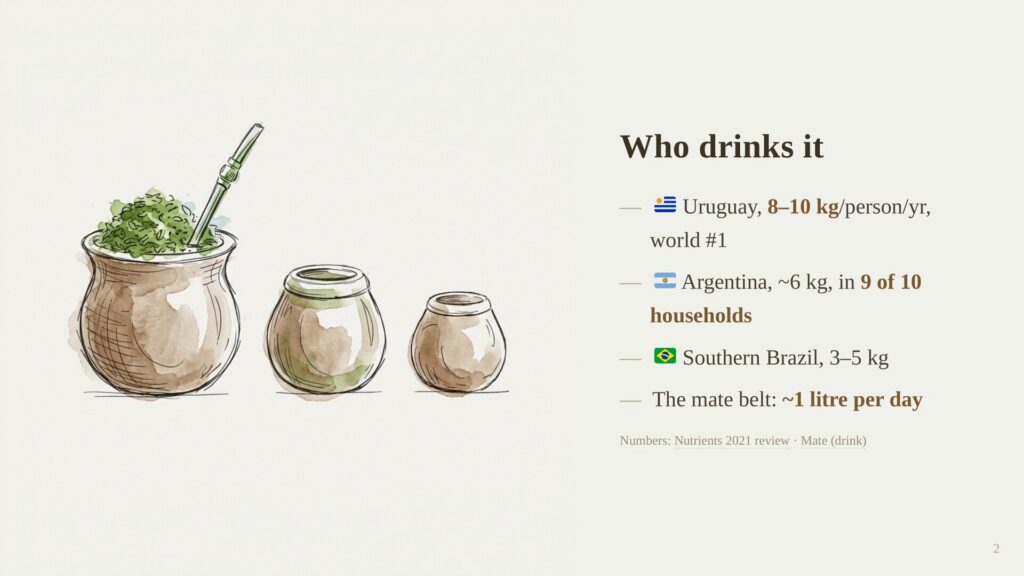
Across the mate belt (Uruguay, Argentina, Paraguay, southern Brazil) people drink roughly a litre a day. Not as a morning ritual or an afternoon pick-me-up, but as something that simply stays with them the entire day. It’s there at breakfast, at work, on a park bench, and it’s there again in the evening.
Today, Brazil, Argentina, and Paraguay together produce around 1.4 million tonnes a year, and less than 5% of that is exported. Mate is overwhelmingly a domestic crop. The rest of the world barely knows it exists.
Same plant, four traditions
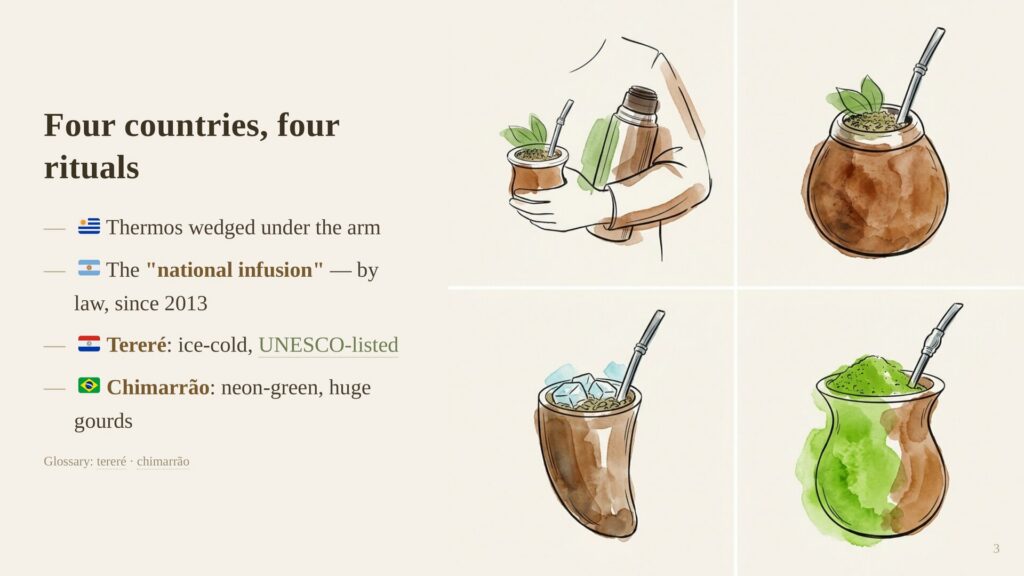
What I found most beautiful in the research is how the same plant becomes something entirely different depending on where you are.
In Uruguay, people carry their thermos wedged under one arm and their gourd in the other, walking, working, shopping. The portable thermos only arrived in the 1960s, and it was a genuine cultural turning point => it made mate something you could take everywhere.
Argentina declared mate its “national infusion” by law in 2013. They celebrate National Mate Day on November 30th. An entire country agreed that this drink deserved its own holiday. Pope Francis was routinely handed gourds by crowds, and he accepted them.
Paraguay flips the whole idea with tereré. The mate is served ice-cold, often with fresh herbs called yuyos.
And in southern Brazil, there’s chimarrão: neon-green, unaged, ground so fine it’s almost powder. A completely different taste, a completely different look. Same plant.
The surprise on the map
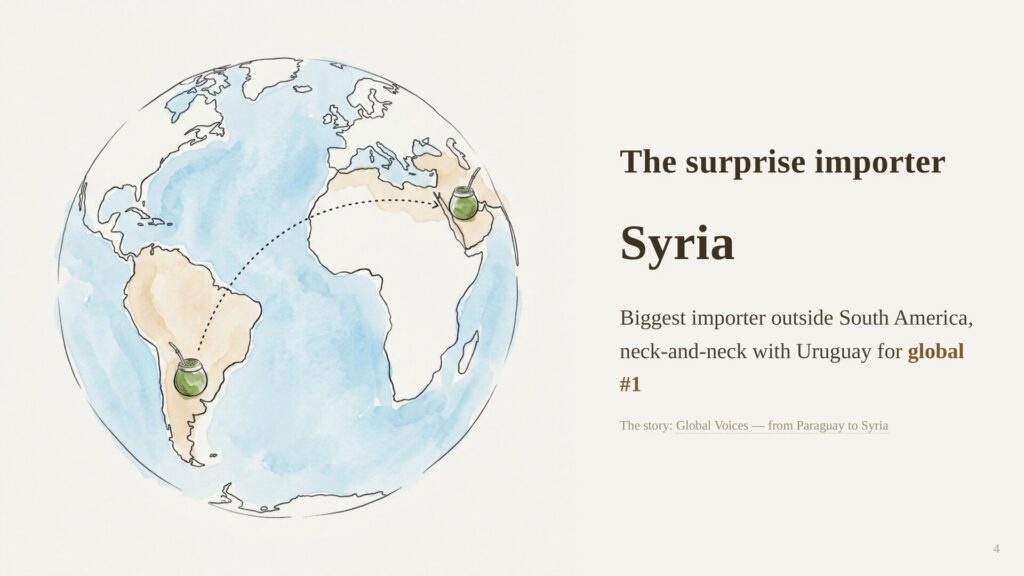
The world’s two biggest consumers are both importers. Currently the world’s biggest importer of yerba mate outside South America is Syria. Neck-and-neck with Uruguay for global number one.
The story is one of those beautiful accidents of migration. In the late 1800s, Syrian and Lebanese emigrants settled in Argentina. They fell in love with mate and, when some of them returned, brought the habit home. It took root hardest in Druze communities and simply never left. Today Syria imports tens of thousands of tonnes a year, roughly $64 million worth, almost exactly what Uruguay spends.
The gear
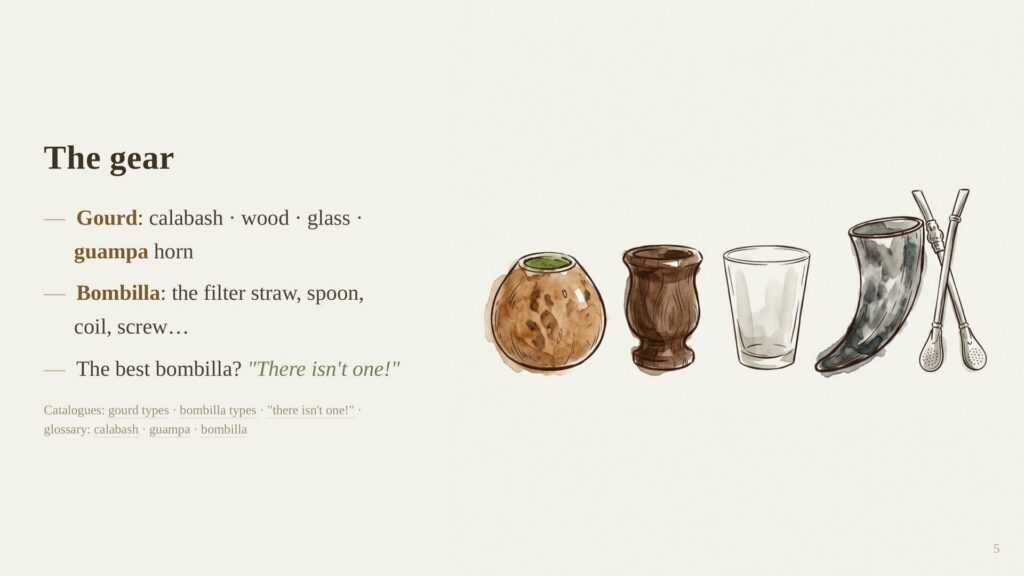
The equipment is simple, but people grow deeply attached to it. The gourd can be a traditional calabash, which apparently can improve with age (mine molded after like 2 weeks), or wood, glass, or a guampa, a horn cup from Paraguay, used only for cold tereré since hot water would crack it.
Some gourds are made from palo santo, a fragrant wood that adds its own sweet flavour to the mate. A new calabash needs curing: you fill it with used yerba and hot water, let it sit for a day, and the gourd slowly seals its pores. It’s a relationship that starts before the first sip.
Then there’s the bombilla, the filter straw. The Brazilian bomba has over 150 holes, designed for chimarrão’s fine powder. Traditional ones are made from alpaca (German silver), which tarnishes beautifully over time. When you ask mate drinkers which one is best, the honest answer is: “There isn’t one!” It depends on the cut, the gourd, the style. You’ll collect several before you find what suits you, and by then each one will have its own little history.
Building the mountain
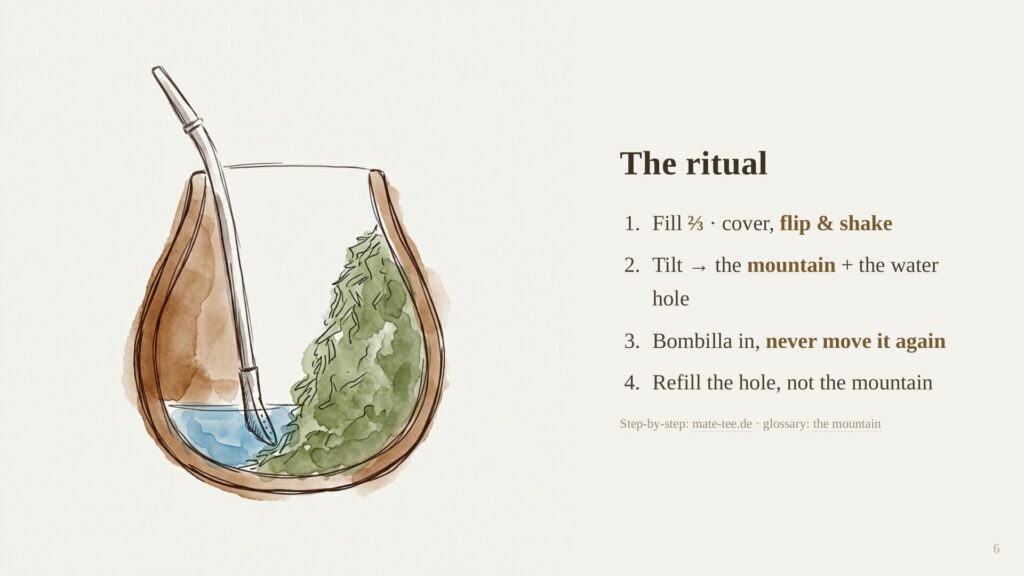
This was the part of the talk where I could actually show something, and it’s also the part where people leaned in.
You fill the gourd about two-thirds with yerba. Cover the opening with your palm. Flip it upside down. Shake gently. This sends the stems to the bottom and the fine dust to the top, so the filter won’t clog later.
Then you tilt the gourd so the yerba forms a slope the mountain on one side, an empty water hole on the other. Some people pour a small splash of lukewarm water (~40 °C) into the hole first and wait a minute or two, the agua tibia protects the leaves from thermal shock. It’s a live debate among materos: some swear by it, some skip it.
The bombilla goes in, angled into the hole. And here’s an reeealy important thing: you never move it again.
Each refill goes into the hole, not over the mountain. The mountain stays dry, slowly releasing its flavour with each pour. A single serving of yerba can last fifteen, twenty, twenty-five refills this way. When you’ve exhausted one face of the mountain, you can turn the yerba, flip the slope with the bombilla to expose the dry side for a second round of fresh flavour. When there’s nothing left to give, you flood the whole thing. And when it finally tastes like water, it’s lavado (washed out).
There’s a beautiful patience to it. In a world that optimises everything for speed, mate asks you to sit with something and let it unfold.
The temperature that matters
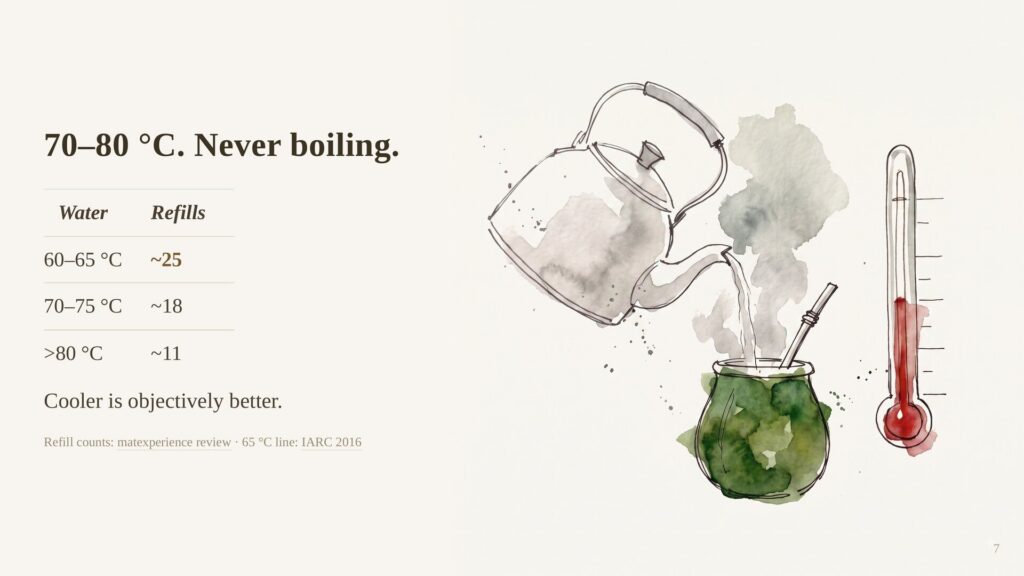
70–80 °C. Never boiling. This was the single most important practical thing I said in the talk.
Boiling water scalds the yerba and cuts your refills in half. At 60–65 °C you get around 25 refills. At 70–75 °C about 18. Above 80 °C you’re down to roughly 11. Cooler water rewards you with more refills, more nuance, a gentler taste.
Sharing a gourd
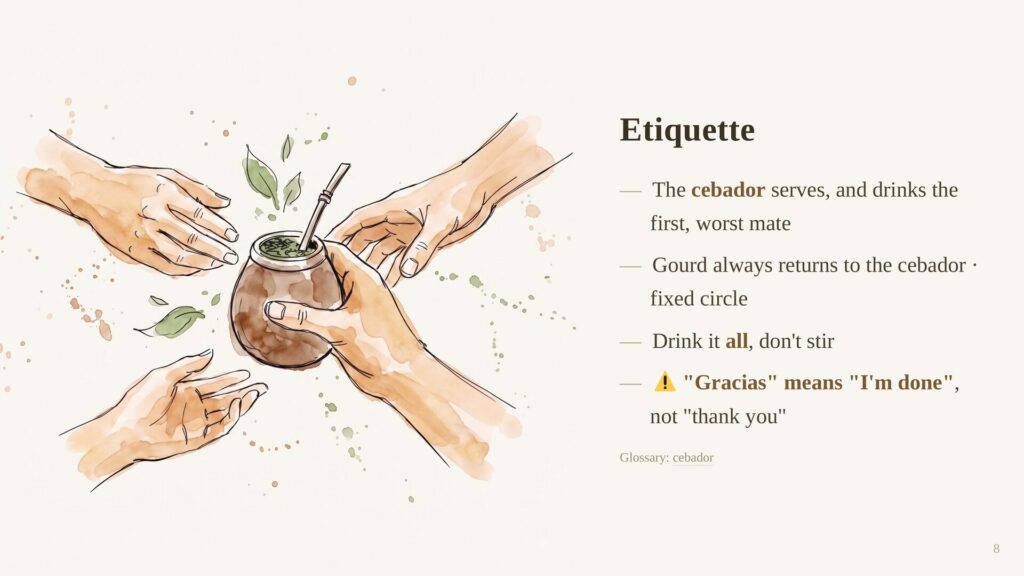
This is the part that moved me most, and the part I think about when someone asks me what mate is really about.
The cebador is the person who prepares and serves, the word comes from cebar, “to prime.” They always drink the first mate themselves (because the first pour is the worst). Bitter, dusty, full of whatever the yerba releases first. There’s even a folk name for it: mate del zonzo, the fool’s mate. They take that on so their guests don’t have to. It’s a small, quiet act of generosity that happens without anyone commenting on it.
The gourd circulates in a fixed direction. When it comes to you, you drink all of it, until you hear the gurgle at the bottom. Don’t sip half and pass it along. Don’t stir with the bombilla. Hand it back to the cebador, who refills and passes to the next person.
And here’s the detail that catches every foreigner: if you say “gracias”, you’ve just told the cebador you’re done. It doesn’t mean “thank you for this round.” It means “I’m finished, no more for me.” If you want to keep drinking, hand the gourd back without a word.
What’s in the bag
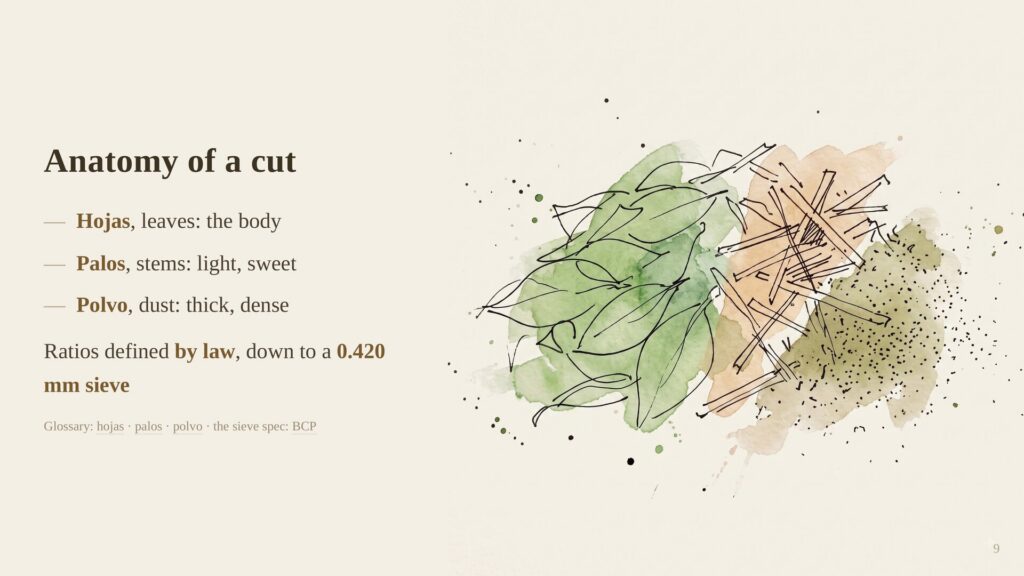
When you look at loose yerba mate, you notice it isn’t uniform. There are three components, and each one has a purpose.
Hojas, the leaves, that’s where the flavour lives. Palos, the stems, lighter, sweeter, but their real job is structural. They give the mountain grip so it doesn’t collapse. And polvo, the dust, fine particles that make the brew thicker and denser.
A whole world of styles
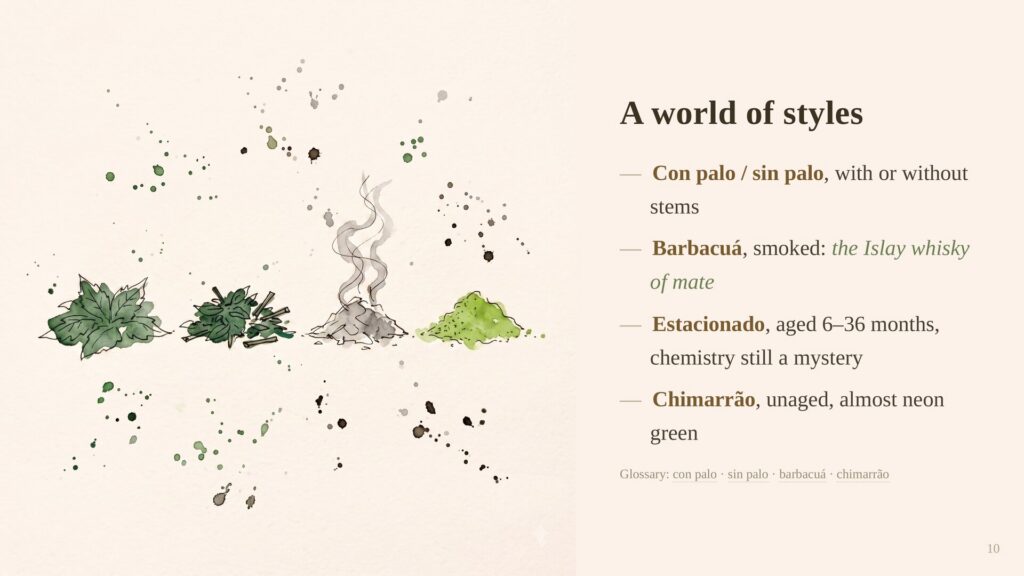
Beyond the cut, processing creates entirely different characters from the same plant.
Con palo versus sin palo, with or without stems, is the most basic split. Con palo is the everyday in Argentina and Paraguay. Sin palo is how Uruguay drinks it: strong, leafy, undiluted.
Barbacuá is the oldest drying method, inherited directly from the Guaraní: wood-fire smoke for 12 to 24 hours. Rosamonte is a classic example, aged 12 months, barbacuá-dried, with a dark-chocolate finish that lingers long after the sip.
Estacionado means aged, anywhere from 6 to 36 months, resting in burlap sacks in controlled conditions. The chemistry of what happens during aging is still not fully understood, the best guess is that it’s similar to tobacco-leaf aging, but nobody’s quite sure. Even the producers will tell you it’s a mystery.
Compuesta is yerba blended with herbs, mint, lemongrass, citrus zest, and it’s where mate starts to resemble a cocktail bar of possibilities. Argentina’s CBSé pioneered this in 1978 (and this brand kinda overdoes it by now – just calling out “dubai cholocate”-mate), and some compuestas are barely 3% added herbs, just enough to tilt the flavour.
Tostada is the Brazilian oddball: roasted like coffee, producing chocolate and nutty notes that taste like they belong to a different plant entirely.
And then there’s chimarrão: unaged, almost neon green, with a fresh, grassy immediacy that aged mates can’t replicate. Like biting into a leaf in spring.
From tree to gourd
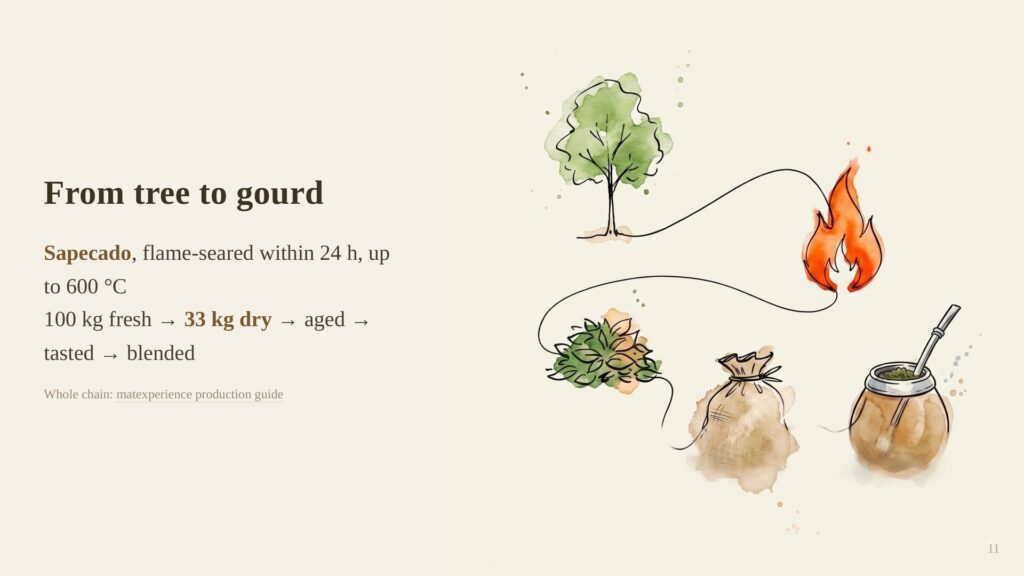
A planted tree takes four to seven years before its first harvest, then gives a crop every two years. Within 24 hours of picking, the fresh leaves are hit with sapecado, a direct flame searing at up to 600 °C. It halts oxidation instantly. It sounds violent, but it’s what preserves everything that makes mate taste like mate.
Then drying, then canchado, a coarse grind that produces the first exportable stage. After that, aging. Then the leaves and stems are milled separately (because they have different hardness and moisture) and blended to meet the legal specifications. Professional tasters check every batch before packaging.
A hundred kilograms of fresh leaf becomes about 33 kg dry. Most commercial yerbas aren’t single-origin, they’re composed by tasters the way tea or whisky blenders work, searching for a balance that holds across seasons.
What the science actually says
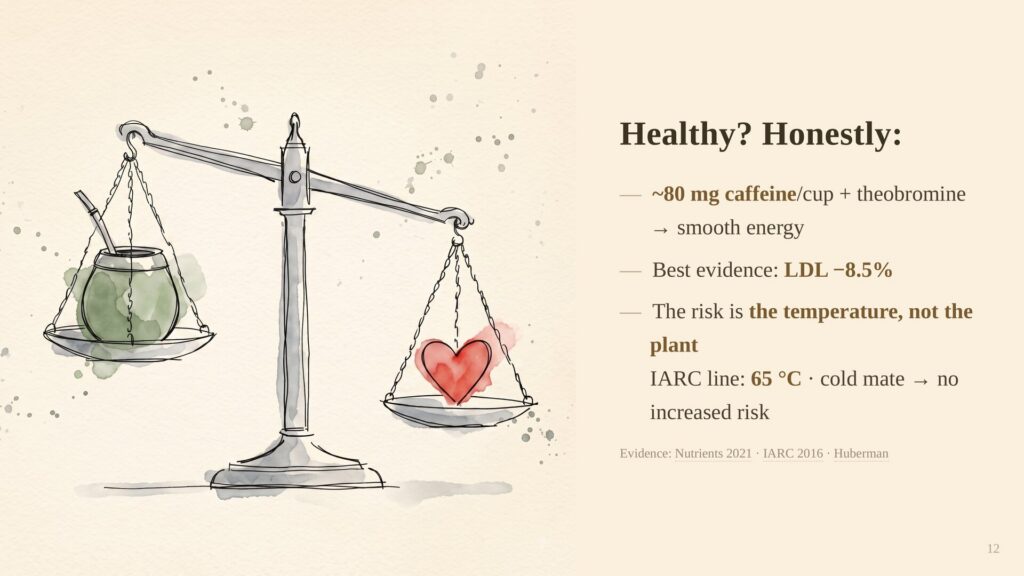
I wanted to be honest about this one, because mate health claims tend to get romantic.
Mate has about 80 mg of caffeine per cup, similar to coffee. But it also contains theobromine, the compound in chocolate that gives a gentler, longer-lasting warmth. The combination is usually credited for mate’s smooth, no-jitters energy, and it’s plausible, though no head-to-head study has proved the mechanism. A full shared session can deliver up to 260 mg of caffeine, roughly three espressos, but stretched over an hour or two with friends, which changes how it feels entirely.
The best-supported health benefit is a reduction in LDL cholesterol, about 8.5% in a 40-day trial with 102 participants (which kinda is not a lot by scientific standards) drinking a litre a day. People already on statins saw an even larger drop of 13%. Beyond that, the evidence gets thinner but stays interesting: a small study found mate increased fat oxidation by 23% during exercise, and an observational study of 146 postmenopausal long-term mate drinkers found 9.7% higher lumbar bone density, though observational studies can only hint, not prove.
The one genuine risk isn’t the plant, it’s the temperature. The IARC’s 2016 assessment was clear: any beverage above 65 °C raises esophageal cancer risk. Cold mate? No increased risk at all. A separate concern: barbacuá-smoked yerba carries about 2.7 times more polycyclic aromatic hydrocarbons (PAHs) than unsmoked, though only around 10% transfers into the water, and a risk assessment concluded the PAH risk is negligible compared to the temperature risk. Flavour and safety agree here. Let it cool. You’ll enjoy it more and it’ll treat you better.
Sources
- Mate (drink), Wikipedia
- History of yerba mate, Wikipedia
- Nutrients 2021 review, health effects and consumption data
- IARC 2016, hot beverages and cancer risk (PDF)
- Global Voices, from Paraguay to Syria
- UNESCO, tereré and pohã ñana in Paraguay
- Yerba mate preparation, mate-tee.de
- Yerba mate production guide, matexperience
- Yerba mate glossary, matexperience
- Types of yerba mate gourds, yerbamatelab
- Types of bombilla straws, yerbamatelab
- “There isn’t one!”, bombilla guide, Circle of Drink
- Huberman on mate, caffeine and theobromine
- Healthline, 8 benefits of yerba mate